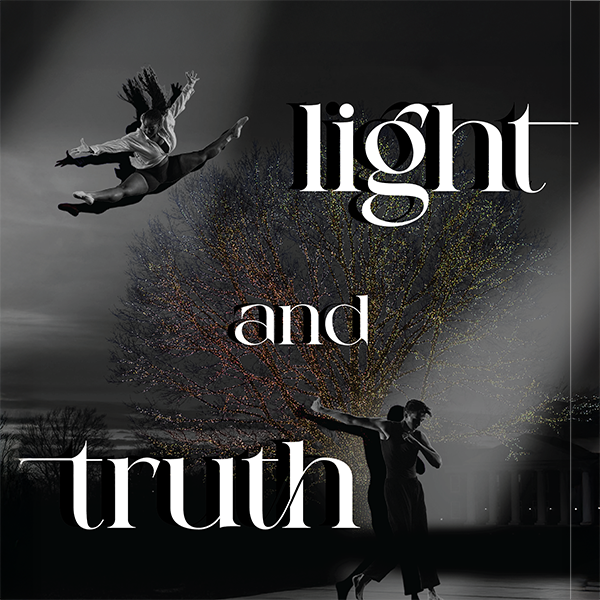
All are welcome to join us for our winter dance performance, “Light and Truth,” inside our Knight Fine Arts Center.
Friday, Dec. 5 | 7:30 p.m.
Saturday, Dec. 6 | 7:30 p.m.
Admission is free with open seating. For those unable to attend in person, Friday's performance will be available via livestream here.
+++
With winter’s swift arrival and Hudson, Ohio blanketed in snow, you might find yourself in need of some warmth — and not just the kind that comes from a mug of cocoa and a big, comfy sweater. The kind that comes from within, from sitting with friends and seeing something dazzling, spectacular, underscored by music, cheering, clapping.
This weekend is the perfect opportunity.
This year’s winter dance performance is titled “Light and Truth,” a nod to the school’s motto, Lux et Veritas, and to its approaching Bicentennial in 2026. But its directors, Director of Dance Katie Velbeck and Assistant Director of Dance Ali Anzaldi ’13, will tell you the theme wasn’t the easy inspiration you might imagine.
“I think what made it a little more challenging is that it’s both abstract and specific,” said Velbeck, with the weary expression of someone who has spent a lot of time thinking about stage lighting and light-themed props. “At first it felt a little narrowing.”
“Plus,” Anzaldi chimed in, “we usually save the abstract themes for spring.”
Which is to say that light and truth, as slippery human concepts, arrived on the syllabus much earlier than expected. And yet the result, if the interview was any indication, is something like a curated exhibit in motion. Classical ballet shares space with modern, jazz with hop hop, and the stage will glow (sometimes literally) with flashlights, candles, light-up glasses and more.
Truth, as it turns out, was the easier of the two to choreograph. “Truth can be interpreted in so many ways,” said Velbeck. “It felt like there were a lot of storytelling paths we could take.”
Light, on the other hand, brings its own burden of symbolism and the weight of expectations. We all think we know what it means. But interestingly, one of the evening's most striking pieces suggests that this certainty can be challenged, even subverted, drawing specific inspiration from another alumnus and recently featured Moos Gallery artist, Mikael Owunna ’08.
A Ballet in Two Acts (And Two Philosophies)
Anzaldi’s advanced ballet work, “Sometimes It’s The Dark That Helps You See,” unfurls in two movements. The first is anchored by Swan Lake’s classical ballet vocabulary: tutus, archetypal binaries, a narrative centered around morality. One class wears black tutus; the other, white, but with black fabric hidden beneath, a visual sleight-of-hand hinting at what’s to come.
We then pivot, abruptly, to the low thrum of Alt-J’s “Fitzpleasure,” as the dancers quick-change into black gowns before re-entering the stage. They move in near darkness, each armed with a small flashlight. Individually choreographed phrases ripple through the dark, the only illumination a roaming constellation of beams.
This inspiration, Anzaldi shared, came from Owunna’s Chapel talk and his works that hung in our Moos Gallery for months. His collection captured the beauty within darkness, highlighting the dark not just as a necessity, but for its own brilliance. “So often, darkness is demonized,” said Anzaldi. “But his artwork is only possible because of it.”
Whether audiences will walk about with this philosophical takeaway is, she noted, besides the point. “Art isn’t prescriptive. People take from it what they take from it.”
Still, the piece lands with strength: opening with the familiar story of light conquering dark, then shifting into a world where they coexist — mutually dependent, equally radiant.
Light and Truth, Explored in Sound and Story
Velbeck, meanwhile, described shepherding her own explorations of the twin themes, set to songs students (humblingly) didn’t always recognize — an occupational hazard of teaching teenagers. When she played “Where is the Love?” by the Black Eyed Peas, the room was met with polite confusion. “At first they thought it was just a song about love,” she shared ruefully.
But repetition works in a quiet rhythm, and before long, the message sank in.
“For us, I think it’s a powerful reminder about how much our world needs compassion, unity and understanding,” said Velbeck. “I think it resonates with all of us, tells us to look inward and choose love in the face of division.”
Soon the dancers were asking questions. One, concerned about maintaining aesthetic integrity, asked: “What should my face be doing?”
Velbeck countered: “What do you think it should be doing?”
The student considered the question. “Well… I want to look cool. But I also want to tell the story.”
Scenes, Sets and Scale
Among the show’s many moments of visual delight is a 1960s diner set, rented from North Coast, featuring chrome trim, barstools and a jukebox — enough to conjure Formica memories in midcentury nostalgia. It’s the perfect backdrop for a jazz piece set to Nina Simone’s “I Wish I Knew How It Would Feel To Be Free.”
In another class of advanced dancers — an all-girls group performing Pink’s “What About Us” — the focus shifted to empowerment: the gap between promises and lived reality, the ache of being overlooked. “The emotional power comes from giving a voice to people who feel unheard,” said Velbeck. “These girls really responded to that.”
This, perhaps, is truth expressed in its simplest, most urgent form; the moment a teenager discovers that the choreography on the stage becomes something else entirely once they decide what they want to say.
It’s worth noting that this year, there are 90 students in the dance program. Doing the rough math, that’s about one in five students on one of the class rosters. For the dance directors, this popularity is both a blessing and a challenge, artistically and logistically.
“Space becomes an issue,” said Anzaldi. “Our stage can only hold so many people. One rogue kick and someone could get hurt!”
To avoid unintended casualties, they often rotate groups on and off the stage. Large numbers, when they work, work spectacularly; an entire class breathing in unison, moving like a single living unit. “It can take your breath away,” said Anzaldi. “But when it doesn’t work… well, it’s obvious.”
Costuming 90 dancers is its own Olympic event. Most of the costumes that come in sets stop at around 16, and when you need to outfit 17, 18, 19 dancers, Velbeck and Anzaldi are sent scrambling. On the ReservedforDance instagram account (give them a follow, if you aren’t already!), they posed a simple arithmetic problem: given the number of dancers, classes, costume changes — how many hangers would they need? The answer (438) earned a collective gasp.
A single show is built on the backs of these many, many, many small details. It’s important to both directors to teach their students more than choreography, but to instill a deep appreciation for the arts and for the unseen, hard work that sustains them.
For many dancers, that appreciation crystallizes during tech week — a phrase that evokes both dread and reverence. It’s taxing, with long hours and constant problem solving. But it’s also that moment the show reveals itself: dancers seeing each other’s work for the first time, cheering with abandon, recognizing the scope of what they have built together.
Anzaldi and Velbeck know this sense of shared community has a ripple effect. One admission officer passed along that witnessing the spring dance performance was what clinched a family’s decision to enroll. After seeing just how much love and support their daughter would receive, they knew WRA was the right place for her.
“I can’t tell you how proud that made me,” shared Velbeck.
Looking to the Next Century
With the Bicentennial providing an opportunity to look forward and back, they find themselves thinking about the next century, and what that holds for the dance program. The truth is, they don’t see a future where it diverges dramatically from its present. The goal is a robust, disciplined program, one that maintains its sense of curiosity and play, of balancing hard work and joy — the true WRA way.
Still, this year’s show does carry a particular resonance. Two pieces were originally choreographed during the COVID-19 era and exist only as filmed productions, never performed before a live audience. Now, for the first time ever, the dancers will bring those works to light.
The metaphor practically writes itself.
As you settle into the seats of the Knight Fine Arts Center theater, you might find yourself preparing for a show that delves into the abstract, symbolic, metaphorical. But in the end, maybe it’s a little simpler. Maybe it’s about 90 young people showing up, moving together and discovering, sometimes slowly, sometimes all at once, that the brightness and joy of the final performance is one that is earned.
Break a leg, Pioneers.


.jpg&command_2=resize&height_2=85 "Time Marches On: 2026 Moving Up Ceremony Celebrates Another Outstanding School Year")





.jpeg&command_2=resize&height_2=85 "Western Reserve Academy Announces 2026 Commencement Speaker")