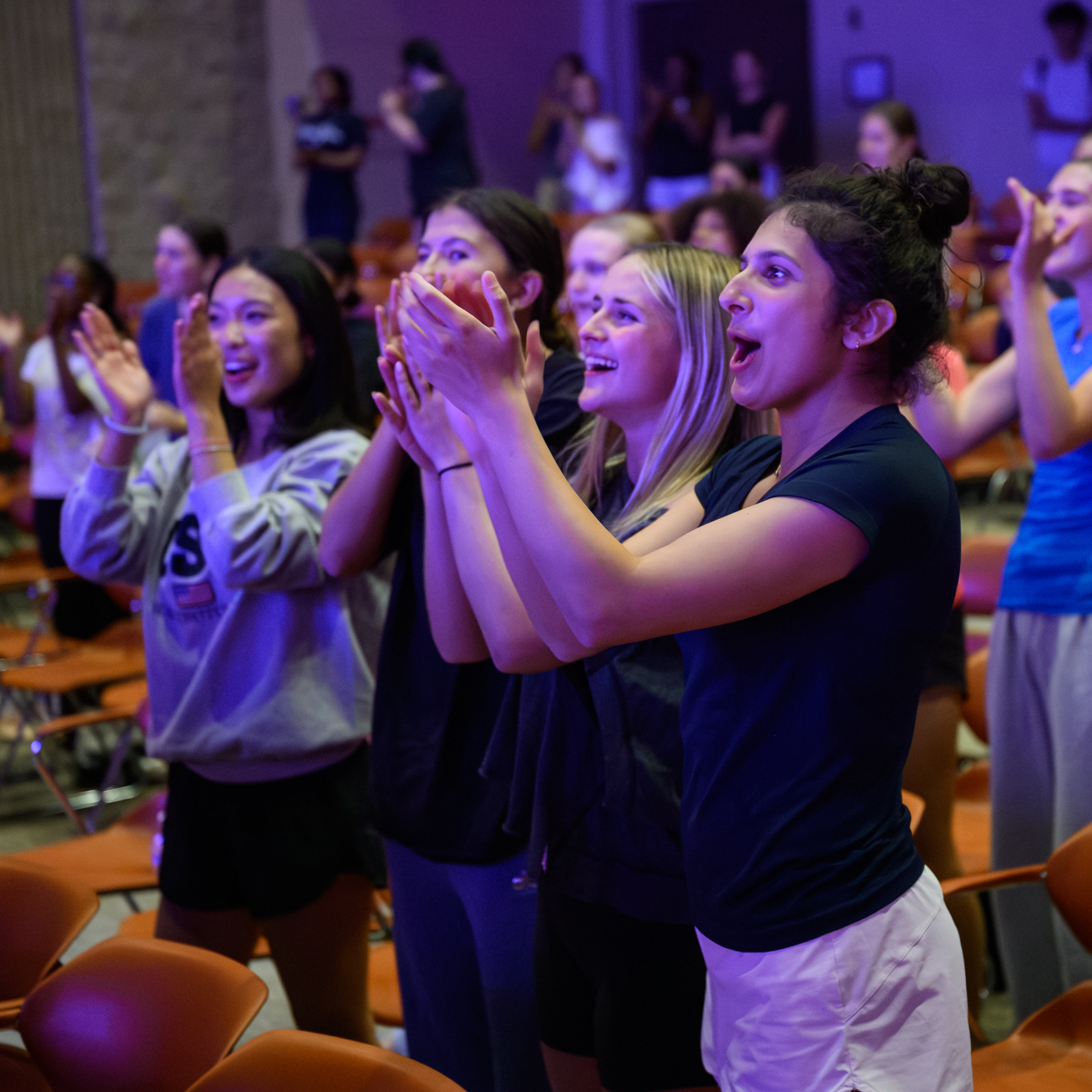
All are welcome to join us in the Knight Fine Art Center theater for our Spring Dance Production and final theater performance, When We Dance.
Friday, May 8 | 7:30 p.m.
Saturday, May 9 | 7:30 p.m.
Admission is free with open seating.
+++
Every interview with Director of Dance Katie Velbeck and Assistant Director of Dance Ali Anzaldi ‘13 includes the same query about the theme of the show — why this theme? What does it mean to you, in your own words? This year’s Spring Dance Performance, When We Dance, asks the same question almost without prompting.
Early in the conversation, Velbeck paused, not for effect, but because the question itself resists an easy answer. When We Dance is meant to be expansive and a container for contradiction: joy and grief, spectacle and restraint, the polished and the unspoken. “Dance helps us express things that we don’t always have words for,” she shared. “That’s what we tried to capture.”
Anzaldi approached the phrase from another angle. Some of her choreography this season is buoyant, jubilant. Other pieces lean toward something heavier. In one, the faint sound of chains thread through the music. It’s not subtle; it’s not meant to be. “We’re dancing to get through a difficult time,” she explained. The movement, in this case, is not decorative. It’s historical, almost archival.
Anzaldi recalled a recent workshop led by alumnus David King ’22, who introduced students to Irish dance. The form, he explained, carries within it the imprint of restriction. Under British occupation, dancing was forbidden, so dancers learned to keep their upper bodies rigid, their arms pinned to their sides, while their feet (hidden behind fences, out of sight) continued anyway. Choosing to dance — choosing joy — in the face of adversity, is an act of rebellion and perseverance; it says everything that words cannot.
Across the program’s 33 pieces, that idea repeats itself in different dialects. A modern piece, entitled Dancing With Your Ghost, explores grief through a seemingly simple casting choice. The class’s lone male dancer takes on the role of the ghost while his classmates embody the relationships left behind. Velbeck described how the class, typically bright and energetic, has been asked to dig deeper, descend into something more internal and dim. It’s a challenge, she described. It’s also the point.
If dance, as both instructors insist, occupies a space beyond language, then it follows that speaking about dance can feel oddly insufficient. “We always joke that we don’t like giving the curtain speech,” admitted Velbeck. “We can dance in front of everyone at the school, but getting up there to speak, to share what this performance means to us, how grateful we are — that’s what makes us nervous.”
As Anzaldi aptly explained, some emotions, joy among them, are simply too large to narrate: “It pours out of you. It’s visceral.”
And yet, this year, words (quietly shared, shushed, texted, schemed) have led to perhaps one of the most shocking elements of the show: a secret performance.
It begins in near-darkness. Members of the Technology Team step onto the stage. As the lights shift, recognition ripples through the audience, and just as quickly, one of the most beloved departments on campus hightails it off the stage to livestream the show. But the stage isn’t empty for long. Enter Reserve’s best kept secret: the faculty ensemble! Thirty adults strong, donned in gold vests (very Bicentennial of them) and, eventually, light-up glasses (very Lux of them).
The choreography unfolds in sections. Small groups enter and exit. Faculty members appear in brief, unexpected cameos. At the center, a trio (The Trio?): Velbeck, Anzaldi, and Director of Student Life Emily Barth, who once led the dance program. “Three generations, in one studio,” said Anzaldi. “It felt like coming home.”
The logistics are, in their own way, improbable. Three rehearsals. Thirty participants. Thirty schedules and after-school commitments to negotiate. A group chat filled with a mixture of pride and disbelief as clips from rehearsals came through. One faculty member, after watching one of the videos, texted simply: Um. Guys. We look so good.
Anzaldi described watching the clips back with pure joy, tears of laughter in her eyes at the antics of one Fine & Performing Arts Department faculty Johnny Buck, dancing with enthusiastic independence in the back of the array. “He said to me, ‘Listen. I’m not that good a dancer. But! I want to put myself out there. I think it’s important for our kids to see that.’”
And that just might be the most distilled version of what the dance program asks of its students.
Beneath the polish of performance (the lighting cues, the costuming, the carefully counted beats) there is something less visible but largely consequential: the act of taking a risk. Students are asked, repeatedly, to move beyond comfort, to inhabit emotions they may not yet fully understand, to memorize movement, to emote at the same time, to stand in front of their peers and be seen. “There’s a vulnerability they have to embrace,” said Anzaldi. And though it doesn’t always arrive immediately, over time, it accumulates.
Tech week tends to bring this into focus. The butterflies in the stomach, restless energy, tightness in the gut, is reframed by Velbeck and Anzaldi as a good thing. It’s evidence that they care. “If you don’t get nervous, that might mean that you don’t care,” said Anzaldi. “And how sad would it be, to go through life not caring?” Velbeck calls the feeling a gift, a signal, a sign that this matters. So bring your A game.
It’s a lesson that travels. Alumni will reach out, again and again, describing how they found themselves on a different kind of stage, like a lecture hall or a boardroom where they gave a presentation to a room full of strangers. The choreography is different, but the muscle memory remains. The ability to stand, speak, perform, has already been quietly rehearsed and the confidence cultivated.
This year’s program, notably, includes eight student-choreographed pieces. Among them, a pointe variation (a rarity for the Knight Fine Arts Center stage) by Brooklyn Haas ’27, a duet by first-year dancers, a senior piece by Addie Mendelson ’26. This last one stars all 20 of the soon-to-be graduates, and this is no small feat. It required coordinating 20 schedules, shaping a work that leans into nostalgia, departure, gratitude, set to Noah Kahan’s “You’re Gonna Go Far.” Both Anzaldi and Velbeck expressed sincerest kudos to her for crafting not only an ambitious piece, but a generous one, one that trades spotlight for ensemble.
This returns us to the beginning — the overall meaning of the show and its impact. At its core, When We Dance suggests we are not only performing. We are remembering, resisting, grieving, celebrating. We are surprising ourselves and each other. And sometimes, under stage lights, in gold vests, alongside 30 colleagues moving in imperfect unison, we are simply trying, bravely and a little nervously, to express something without having to say it at all.
We simply can’t wait to take it all in.
Break a leg, Pioneers.


.jpg&command_2=resize&height_2=85 "Time Marches On: 2026 Moving Up Ceremony Celebrates Another Outstanding School Year")





.jpeg&command_2=resize&height_2=85 "Western Reserve Academy Announces 2026 Commencement Speaker")